
eKasa in 2026: who needs an online cash register and what changed on 1 January
Since 1 January 2026 Slovakia has a new revenue recording act (No. 384/2025). It changes two things, and each of them touches almost every small business.
First: the exemptions for services are gone. Some activities used to be exempt by SK NACE code. Not any more. The obligation now covers all services, craft trades included.
Second, and more important: from 1 May 2026 you must give the customer the option to pay cashlessly (by card, transfer or QR code) on any purchase above one euro.
Below is who this applies to, who it does not, and what to do about it.
To be clear from the start: I do not register companies, keep books or handle taxes: that is a notary's and an accountant's job. My work begins after the register entry: website, domain and email, advertising, analytics. This article is here so you know the order of steps.
Need a new website?
A company site, an online shop or a booking system. 95% of projects ship within 15 working days.
Who needs an eKasa
The obligation to record revenue applies to sellers (individuals and companies holding a business authorisation) who take payment for goods or services in cash or by card on the spot. Where you live or are registered makes no difference.
The key phrase is cash or card on the spot. If you issue an invoice and the client pays by bank transfer, you do not need an eKasa. That is exactly why many B2B companies operate without a cash register at all, entirely legally.
But if you run a salon, a shop, a workshop or a café, or you take card payment when visiting a client, the register is mandatory.
Who is exempt
The law keeps a limited list of exceptions, among them:
- sale of securities (but not single-purpose vouchers)
- sale of precious metal coins and commemorative banknotes at numismatic exchanges
- sale of postage stamps at philatelic exchanges
- sale of goods and services by an entrepreneur or their employees with a severe disability
- sale of live animals
- goods and services produced as part of students' practical training
- sale through vending machines
If your activity is not on that list, you need a register. And that is precisely what changed: the list of exemptions used to be considerably longer.
Three kinds of register
The new act recognises three options:
| Type | What it is | Who it suits |
|---|---|---|
| ORP: online cash register | a physical device | fixed premises with heavy traffic |
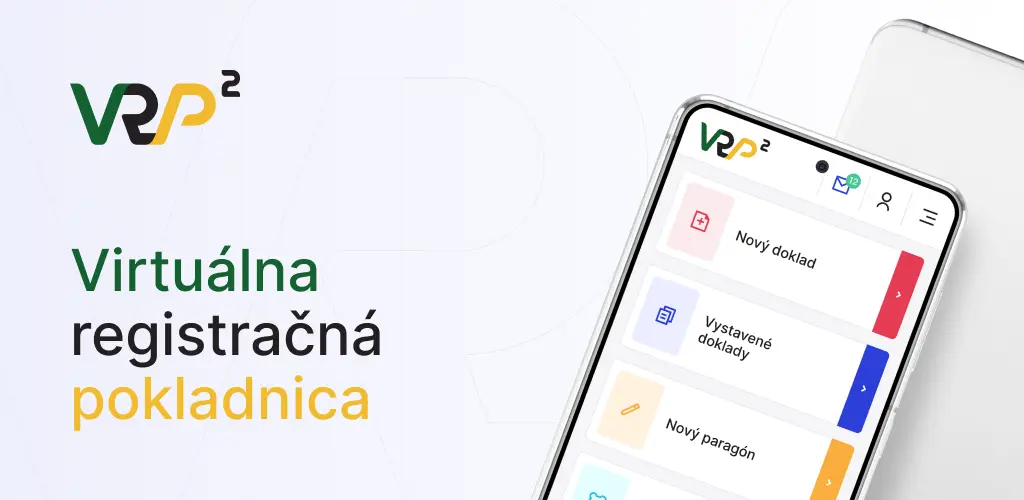
| VRP: virtual | an app on a phone or tablet | small turnover, work on the move |
| Software (cloud) | the register as a service | integration with a website, shop or CRM |
The software register entered the law as a category of its own in 2026. For anyone selling through a website who wants receipts issued automatically, it is the most practical option.
The main change: cashless payment from 1 May 2026
This is the part almost nobody is thinking about yet, and the date is close.
From 1 May 2026 a seller must give the buyer the option to pay cashlessly (by card, transfer or QR code) on any purchase above one euro. The single exception is no internet connection at the point of sale.
The wording of the law matters: the duty is not to install a terminal but to make it possible. A QR code for a transfer meets the requirement and costs less than a terminal.
The penalty for non-compliance is 500 to 15,000 euros.
Shall we talk about your project?
Send a few lines about what you need. I reply within 24 hours, no obligation.
The mandatory notice on the premises
One more new duty: sellers accepting cash or the listed cashless methods must display, in a visible and clearly legible place, a notice stating that they are obliged to record revenue.
A small thing, and exactly the kind of small thing an inspection catches.
Penalties
The sanctions were tightened:
- first breach: 500 to 15,000 euros
- repeat: 3,000 to 40,000 euros
- separately for failing to accept cashless payment: 500 to 15,000 euros
- in serious cases the financial administration may propose withdrawal of the trade licence
A separate reminder about cash limits: cash payments above 5,000 euros are prohibited, and between private individuals outside business above 15,000 euros.
What this means for your website
Here is the part that usually gets missed, and it costs money.
If you sell through a website, accepting payment is no longer a "someday" item. The 1 May requirement applies to the sale as such, and it is more sensible to solve it once: add card payment on the site rather than buying a terminal for every point of sale.
A software register integrates with the website. Order placed, receipt issued automatically, no manual entry. For an online shop that is the difference between "someone types in every order" and "it happens by itself".
A QR code for a transfer is the cheapest way to close the requirement where a terminal does not pay for itself. It can be generated and displayed both on the premises and on the payment page.
And on measurement. If you take payment online, set up tracking straight away: how many orders reach payment and how many fall away halfway. Without it you find out about a problem in the checkout six months later from the revenue figures, rather than a week later from a report.
Common mistakes
Assuming a craft trade is still exempt. It is not. That changed on 1 January.
Treating 1 May as an issue for shops only. It applies to services too, including a courier taking payment on delivery.
Buying a terminal reflexively. For low volumes a QR code satisfies the same requirement at a fraction of the cost.
Leaving the notice off the wall. It is a formality that carries a real fine.
If you need the website side of it
I set up card payment on websites, connect payment gateways, and wire the whole thing to measurement so it is clear how many orders actually reach payment. Details on the web development service page.
I have lived in Slovakia for over ten years, work as a Slovak s.r.o. and issue a faktúra with an IČO.
Related: accepting card payments on your website, VAT registration in Slovakia and opening an s.r.o..
Want to know what is holding your site back?
I go through it the way Google sees it and send a concrete list within 3 working days.