
A website for a sports club, dance school or children's group: how to build one that stays alive
A club website is usually born out of enthusiasm: a parent "knows a bit of WordPress", a template gets picked over a weekend, photos go up and the home page gets an invitation to a tournament. Six months later the invitation is still there, the tournament is past, the gallery plugin broke and nobody remembers the admin password.
Below: why it happens, what a parent actually looks for, how to build a site that updates itself, what it costs and when a site is not needed.
Need a new website?
A company site, an online shop or a booking system. Most projects ship within 15 working days.
Why club websites die
A sports club, a dance school or a children's group has more events than most businesses: competitions, enrolment rounds, training camps, results, holiday timetable changes. And it has nobody to look after the site. The coach coaches. Parents help as much as they can, and when their child leaves the club, they leave too, password and all.
The result is always the same: a club site goes stale faster than any other. The home page carries a notice from last season, the timetable shows hours that no longer apply, and the last item under "News" is two years old. A parent choosing an activity for their child sees an abandoned site and draws the obvious conclusion: the club has probably closed.
What a parent actually checks
A parent does not come to admire the design. They come with questions and want them answered on a phone, in a lunch break, in two minutes:
- Is the club alive? Recent photos, results, anything with this year's date on it.
- What ages? Groups by year of birth, whether beginners are welcome.
- When and where training happens: timetable, address, how to get there.
- What it costs and what the fee includes.
- Who coaches: names, photos, background.
- How to sign up: a form right there, not "write to us".
- Results and photos, to see how far a child can go.
The first question matters most and fails most often.
Two separate worlds and one fix: the site pulls from Instagram on its own
Almost every club has a living Instagram. Training photos, results, a moved session: it all goes up as it happens, because the coach can do it from a phone in a minute. And the website is dead at the same time. Not because the club has no content, but because the content lives somewhere else and nobody carries it across.
Nobody will write the same thing twice, once for Instagram and once into a website admin panel. Whoever promises to will last a month.
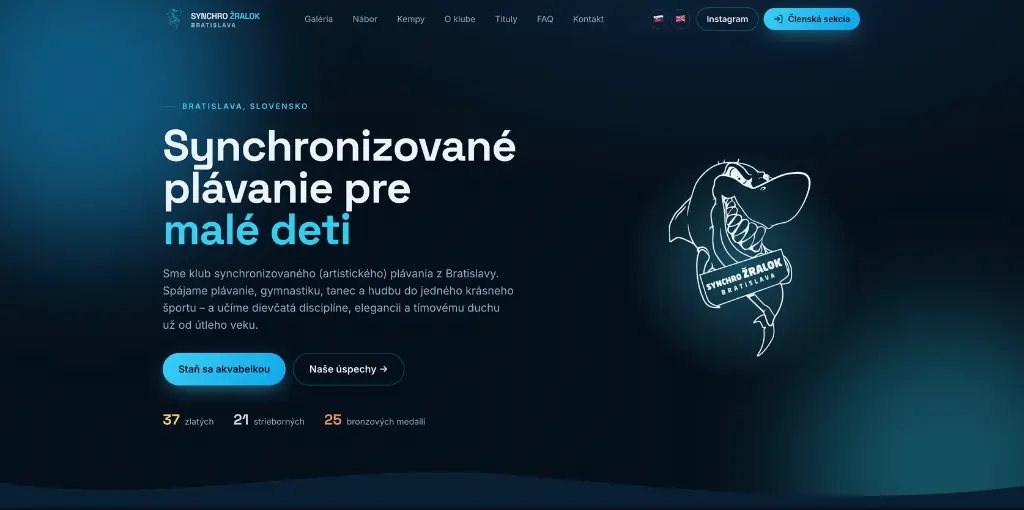
That is what I solved for Synchro Žralok, a synchronised swimming club in Bratislava. The site pulls posts from the club's public Instagram automatically. The coach posts a photo from a competition the way they always did, and it appears on the site with no further step.
That removes the main reason club websites die: doing the same work twice. A parent who opens the site while looking for an activity sees a living club with recent photos and results, not last year's notice.
What has to be on the site and not on Instagram
Instagram is good for what changes every week. For what changes once a season it is bad: nobody will find a timetable in a post from three months ago, prices in a story vanish after a day, and Google reads a fraction of Instagram compared with a website. A parent who types "dance school for children Ružinov" into Google will not get Instagram in the results.
So the permanent things live on the site:
- The timetable as text on the page, not a photo of a table.
- Prices and what they include: membership, camps, entry fees.
- A sign-up form with a note on what happens after sending.
- Documents: a downloadable application, consents, statutes if the club needs them.
- Contacts and address with a map.
- Mandatory legal details of the organisation.
A civic association or an s.r.o. must show its details on the site: name, registered address, IČO, registration data (the full list). If analytics runs, a cookie bar with Consent Mode v2 is required (why and how).
One evening's work at launch, then once a season; everything that changes often arrives from Instagram by itself.
Sign-up: a form that reaches the right person
"Email us" is the worst way to sign up. The parent does not know whether the message arrived, the club does not know whether it went to spam.
The right way is a form with the fields the club really needs (child's name, year of birth, group, parent's contact), with spam protection and verified email delivery so nothing lands in junk mail. The parent gets a confirmation, the club gets the application. If the coach lives in a phone rather than email, a Telegram notification can be added: the application arrives as a message and nobody has to open anything.
Shall we talk about your project?
Send a few lines about what you need. I reply within 24 hours, no obligation.
Two languages for a club in the capital
Bratislava has many international families, and for them English is often the only way to find out where to enrol a child.
Done right, it looks like Synchro Žralok: a Slovak and an English version, each on its own URL, linked by hreflang. A visitor whose system is Slovak lands on the Slovak version, everyone else on English, and the switcher stays: the choice is always the visitor's. A switcher that swaps text over a single URL is the wrong approach: Google indexes one version and nobody finds the other. Whether a Slovak version is needed at all when the clients speak other languages: do you need a Slovak website.
A Google profile and measuring sign-ups
The club should have a Google Business Profile with its address, training hours, photos and a link to the site. For a search like "swimming club Petržalka" it is the first thing a parent sees. Reviews from happy parents are the cheapest recruitment there is. How traffic grows without an advertising budget: how to grow website traffic.
Measure sign-ups, not views. A thousand page views say nothing; twenty submitted applications in an enrolment month say everything. In GA4 the form submission, a tap on the phone number and a tap on directions become conversions, and you see whether recruitment through the site works. How to do it: GA4 setup. More on the analytics service page.
What a club site does not need
- Member logins at the start. A members' area makes sense once there is something behind it; at launch it is a locked empty room.
- A forum. Parents talk in a WhatsApp group and will not move anywhere else.
- A news CMS that nobody will fill. That is precisely what kills club websites.
- A free template from Webnode or Wix with their adverts and somebody else's domain. Why that ends up expensive: free website builder vs custom.
Paying membership fees online is a sensible second step once sign-ups through the site are coming in and the club wants to stop chasing bank transfers. Card payments can be added later: accepting card payments.
Who else this fits, and when a site is not needed
The story is the same for a dance school, a language school, an art studio, a music school, a children's activity group, a small non-profit, a church community. Everywhere the content exists, but it sits on social media and the site stands empty. The automatic link solves that once and for all; the rest differs only in the details.
If the club is full through word of mouth, does not recruit and has a waiting list a year long, it does not need a website. A Google profile with address and hours plus Instagram is enough. A site makes sense when the club wants parents who have never heard of it to find it and enrol a child without a phone call.
What it costs
- A landing page with timetable, prices and a sign-up form: from 1 500€.
- A club site in two languages with automatic content from Instagram and sign-up: from 3 500€.
- Changes to an existing site, such as adding a form or a feed: 35€/hour.
Delivery averages 10 working days, with 90% of projects done within 15. Included: mandatory legal details, cookie bar, Google Business Profile, sign-up tracking, domain, hosting and accounts registered to the club, six months of support. What makes up the price: what a website costs.
If you need help
I build websites for clubs, schools and studios: the site itself, the automatic link to Instagram, a sign-up form that reaches the right person, the Google profile and sign-up tracking. I do not run the club's social media, I do not take photos, and I do not handle registering the association or grant applications; my part is the website and what comes through it.
I have lived in Slovakia for more than ten years and have launched 12+ websites for Slovak companies, among them Synchro Žralok, Biliardovňa and Krása štúdio OK. I work as a Slovak s.r.o. in Bratislava, invoice with an IČO, and work in Slovak and Russian.
Details on the web development service page. If the club already has a site and no sign-ups come through it: free audit, results within 3 working days.
Want to know what is holding your site back?
I go through it the way Google sees it and send a concrete list within 3 working days.